
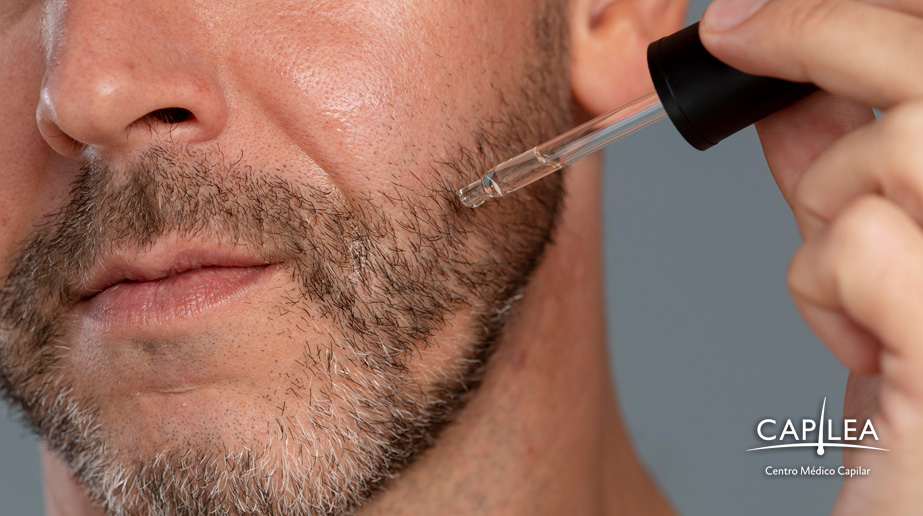
Wondering does minoxidil work for beard growth and whether it’s worth trying? You’re not alone. It’s one of the most common questions among men looking for a fuller beard.
In this guide, we’ll explain what the clinical evidence says, how minoxidil works, how long it takes to see results, and when it makes sense to consider a beard transplant instead.
Does minoxidil work for beard growth?
Yes. Clinical evidence suggests that topical minoxidil can improve beard density in men who already have facial hair follicles.
One of the most frequently cited studies is a randomized, placebo-controlled clinical trial conducted in 2016 at Mae Fah Luang University in Thailand. The study included 48 men between the ages of 20 and 60 who wanted to improve beard growth. Participants applied:
- 0.5 mL of 3% topical minoxidil (or placebo)
- To the chin and jawline
- Twice daily for 16 weeks
The minoxidil group demonstrated greater improvement in photographic assessments, facial hair counts, and self-reported satisfaction compared with the placebo group.
The researchers concluded that 3% topical minoxidil is both effective and safe for increasing beard density.
More recently, a 2025 review published in the Journal of Family Medicine and Primary Care also concluded that low-dose topical minoxidil is an effective treatment for enhancing facial hair growth, with relatively mild side effects.
How does minoxidil work on the beard?
Minoxidil was originally developed as a medication to treat high blood pressure. During clinical testing, researchers noticed that it also stimulated hair growth.
When applied to the beard area, it works in two main ways:
- Improves blood flow to the hair follicle: It increases circulation, delivering more oxygen and nutrients to facial hair follicles.
- Extends the anagen (growth) phase: This encourages thin, fine hairs to develop into thicker terminal hairs.
This explains why many men first notice soft, light-colored “peach fuzz” before seeing a fuller beard. Over time, those fine hairs can mature into darker, thicker terminal hairs.
However, it’s important to understand one limitation: Minoxidil cannot create new hair follicles. Instead, it stimulates follicles that already exist but are producing very fine or barely visible hair.
Your genetics remain the biggest factor. If hair follicles are present, minoxidil may help maximize their growth potential. If no follicles exist in an area, there is nothing for the medication to stimulate.
How long does it take to see beard growth?
Consistency and patience are essential. Most men require several months before noticeable improvements appear.
| Timeline | What to expect |
| First few weeks | Mild shedding may occur. This is usually temporary and signals that follicles are entering a new growth cycle. |
| Months 1-3 | Fine, light “peach fuzz” begins to appear, indicating that follicles are responding. |
| Months 3-6 | Hair becomes darker and thicker. Beard coverage starts improving, and patchy areas become less noticeable. |
| Months 6-12 | Significant improvements in density and coverage. Many transitional hairs become terminal hairs. |
| Months 12-24 | Terminal hair development is largely complete. At this stage, some physicians may recommend gradually reducing treatment. |
Most specialists recommend using minoxidil for at least six months before deciding whether it has been effective.
Are beard minoxidil results permanent?
The answer differs from scalp hair treatment. For androgenetic alopecia, minoxidil must usually be continued indefinitely because the hormonal process causing hair loss remains active.
Facial hair behaves differently. Unlike scalp follicles, beard follicles are not progressively damaged by DHT. Clinical experience suggests that once facial hairs fully mature into terminal hairs, much of the improvement tends to remain even after stopping treatment.
However, immature fine hairs may still be lost if treatment is discontinued too early. For this reason, maintaining treatment until hairs have fully matured -which may take anywhere from 6 months to 2 years– offers the best chance of lasting results.
What minoxidil can and cannot do
| Minoxidil can | Minoxidil cannot |
| Increase beard density in patchy areas | Create new hair follicles |
| Convert fine hairs into thicker terminal hairs | Guarantee identical results for everyone |
| Help connect sparse beard or mustache areas | Produce significant growth within a few weeks |
| Improve beard fullness in many men | Replace a medical evaluation if side effects occur |
| Help maintain terminal hairs after maturation | Restore areas with no existing follicles |
Individual results vary considerably because genetics and existing follicle density play such important roles.
Is minoxidil safe for beard growth?
Clinical studies have shown that topical minoxidil is generally well tolerated.
Common side effects
Dry skin, mild redness, flaking or scaling, mild contact dermatitis, often caused by propylene glycol in liquid formulations. Many men who experience irritation find that switching to the foam version reduces these symptoms.
Less common side effects
Unwanted hair growth on nearby areas such as the upper cheeks, temples, or forehead if the product spreads beyond the treatment area or persistent itching beyond the first few weeks.
You should stop treatment and consult a healthcare professional if you develop: severe irritation, eczema, psoriasis flare-ups, open wounds and persistent allergic reactions.
Medical evaluation before beginning treatment is always recommended. Many physicians also advise performing a small skin patch test 48 hours before applying minoxidil to the face.
How to use minoxidil for beard growth
Although treatment should always be individualized, commonly recommended guidelines include:
- Concentration: Start with 3% topical minoxidil. If well tolerated, your physician may recommend increasing to 5%.
- Amount: Approximately 1 mL daily (0.5 mL per side), ideally divided into two applications.
- Application: Apply to clean, dry skin and spread evenly with your fingertips. Wash your hands afterward.
- Shaving: Shaving does not affect effectiveness because minoxidil acts beneath the skin at the follicle level. Avoid applying immediately after shaving if your skin is irritated.
- Consistency: Daily use is one of the strongest predictors of successful results.
What if minoxidil isn’t enough?
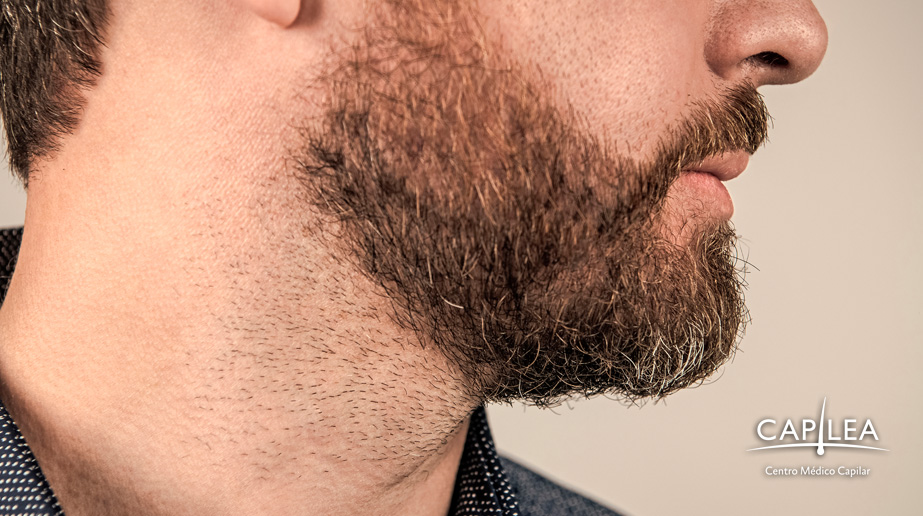
While minoxidil is highly effective for stimulating existing follicles, it cannot create hair in areas where follicles are absent.
If you have extensive patchy areas, beard scars, naturally sparse facial hair or minimal improvement after long-term consistent use, a FUE beard transplant may provide a more permanent solution.
At Capilea México, healthy hair follicles are carefully transplanted from the donor area -typically the back of the scalp- to areas of the beard that require additional density. The result is permanent, natural-looking facial hair that continues growing just like your original beard.
Many patients also combine both approaches, using a beard transplant to establish density while supporting surrounding hairs with minoxidil under medical supervision.
Schedule your consultation at Capilea México
Every beard is different. The best way to determine whether you’re a candidate for topical minoxidil, a beard transplant, or a combination of both is through a professional evaluation.
At Capilea México, our specialists assess your facial hair density and donor area to recommend the solution that offers the most natural and lasting results.
Schedule your consultation today and take the first step toward achieving the fuller beard you’ve been looking for.
FAQ
How long should I use minoxidil for my beard?
Most specialists recommend using topical minoxidil for at least 6 to 12 months. Some men continue treatment for up to 18 to 24 months to maximize terminal hair development.
Can I shave while using minoxidil?
Yes. Shaving does not interfere with treatment because minoxidil works beneath the skin at the follicle level.
Can minoxidil fill beard patches?
It can improve patchy areas if hair follicles are already present. If no follicles exist, a beard transplant is generally the most effective solution.
Does oral minoxidil work for beard growth?
Most of the available scientific evidence supports topical minoxidil for facial hair growth. Low-dose oral minoxidil is primarily prescribed for scalp hair loss and should only be used under medical supervision because of its potential cardiovascular effects.