
Hair loss affects millions of men and women worldwide, driving constant innovation in treatments that promise thicker, healthier hair. One of the most talked-about solutions today is stem cell hair restoration, but does it actually work? And how does it compare to proven procedures like FUE?
In this guide, we’ll break down what stem cell hair transplantation involves, how it differs from traditional methods, and what results you can realistically expect.
What is stem cell hair restoration?
Stem cell hair restoration is an emerging treatment that uses regenerative cells to stimulate hair growth. The idea is simple but powerful: instead of just relocating hair, stem cells aim to regenerate and reactivate dormant or weakened hair follicles.
How does it work?
- Extracting cells: A small sample of tissue -usually from the scalp or fat tissue- is collected.
- Isolating stem cells: These cells are processed in a lab or specialized device to isolate regenerative components.
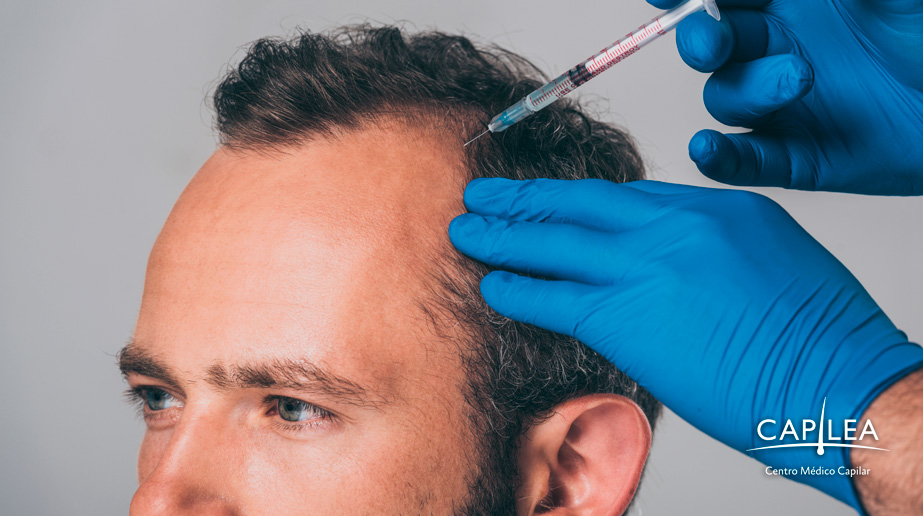
- Injecting into the scalp: The concentrated solution is injected into areas affected by hair thinning or loss.
The goal is to trigger natural hair growth by improving follicle health and extending the growth phase of the hair cycle.
Does stem cell hair restoration actually work?
It shows promise, but it’s not a complete replacement for traditional hair transplants.
- Safety: Reliable and controlled application throughout the treatment process.
- Hair density improvement: Increases the number of hairs per cm² by reactivating dormant follicles and prolonging the growth phase.
- Greater hair thickness: Promotes stronger, thicker hair by improving the health and activity of the hair follicle.
- Best results in early and moderate stages: More effective when the follicle is still active, before advanced hair loss occurs.
Measurable results
Initial changes can be observed around the first month. Peak improvement in density and thickness is typically reached between 3 and 6 months, and results tend to stabilize between 6 and 12 months.
✔️ Increases of up to +23 hairs/cm²
✔️ Improvement in hair thickness of up to +28%
✔️ Over 90% satisfaction in some studies
✔️ Visible results from week 4
Are there any side effects?
One of the most positive aspects is its safety profile. The most common side effects include:
- Mild redness: Appears in the treated area after the procedure and usually disappears within a few hours or days.
- Temporary swelling: Slight increase in volume in the treated area as a normal response of the body.
- Sensitivity in the treated area: Some discomfort or tenderness to the touch may be felt during the first few days.
In most cases, these effects are mild and temporary, resolve within a few days, and do not require additional treatment.
What is FUE (Follicular Unit Extraction)?
FUE is a well-established hair transplant technique that involves removing individual hair follicles from a donor area (usually the back of the scalp) and implanting them into balding areas.
- Minimally invasive procedure
- Leaves no linear scar
- Uses your own natural hair
- Provides permanent, visible results
Unlike stem cell therapy, FUE physically relocates hair follicles, making it a more predictable solution for moderate to severe hair loss.
Stem cell hair restoration vs. FUE
| Feature | Stem Cell Hair Restoration | FUE (Follicular Unit Extraction) |
| Approach | Regenerates and stimulates existing hair follicles using stem cells or growth factors | Extracts and transplants individual hair follicles from donor to recipient areas |
| Type of procedure | Non-surgical or minimally invasive (injections) | Minimally invasive surgical procedure |
| Goal | Improve hair density, thickness, and follicle health | Restore hair in balding areas with permanent follicles |
| Best candidates | Early to moderate hair thinning | Moderate to advanced hair loss |
| Results | Gradual, subtle improvement | Noticeable, defined, and long-lasting results |
| Time to see results | 1–3 months initial changes; peak at 3–6 months | New growth starts at 3–4 months; full results at 9–12 months |
| Longevity | May require maintenance sessions | Permanent results (transplanted hair is resistant to hair loss) |
| Combination potential | Often used to enhance or support other treatments | Can be combined with regenerative therapies for better outcomes |
Can stem cell therapy replace hair transplants?
While stem cell hair restoration is exciting, it currently works best as a complementary treatment rather than a standalone solution.
Many clinics are now combining approaches FUE for restoring hairlines and density + stem cell or regenerative therapies to enhance healing and improve overall hair quality. This hybrid strategy often delivers the most natural-looking results.
Am I a good candidate for stem cell hair restoration?
You may be a good candidate if you are in the early stages of hair thinning, are looking to improve hair thickness and quality or want to support or enhance a previous hair transplant. However, if you have significant bald areas, a surgical option like FUE is typically more effective.
Stem cells vs. other hair loss treatments
| Feature | Stem Cells | PRP (Platelet-Rich Plasma) | Mesotherapy | Minoxidil | Finasteride |
| Type of treatment | Regenerative | Biostimulation | Nutritional/Stimulant | Topical pharmacological | Oral pharmacological |
| Mechanism of action | Regenerates the follicular environment and reactivates follicles | Stimulates follicles with growth factors | Delivers vitamins and medications to the follicle | Prolongs the growth phase | Reduces DHT (hormonal cause) |
| Depth of action | High (cellular level) | Medium | Medium–superficial | Superficial | Systemic |
| Effectiveness | High in early/moderate stages | Moderate to high | Moderate | Moderate | High (with continuous use) |
| Onset of results | 1–3 months | 2–3 months | 1–2 months | 3–6 months | 3–6 months |
| Duration of results | Medium (requires maintenance) | Temporary (requires maintenance) | Temporary (requires sessions) | Only while in use | Only while in use |
| Frequency | 1–2 sessions + follow-up | 3–4 sessions + maintenance | Periodic sessions (weekly/monthly) | Daily use | Daily use |
Thinking about hair restoration?
The right treatment depends on your level of hair loss, goals, and expectations. A professional evaluation can help determine whether stem cell therapy, FUE, or a combination of both is the best path forward.
Schedule an appointment with our hair specialists and receive an accurate diagnosis to determine whether you are a candidate for treatment or a hair transplant, and start restoring your hair and confidence as soon as possible.
FAQ
Can stem cells completely stop hair loss?
They can significantly reduce it, but their effectiveness depends on the condition of the follicle and the type of alopecia.
Can they be used at any stage of hair loss?
They are most effective in early and moderate stages. In advanced stages, they are often combined with a hair transplant.
How long do the results last?
Results can last several months, but in some cases, maintenance sessions are recommended to prolong them.
Does this treatment replace minoxidil or finasteride?
Not necessarily. In many cases, they are combined to enhance results.
Is there a risk of rejection?
No, especially when autologous cells (from the patient’s own body) are used.