
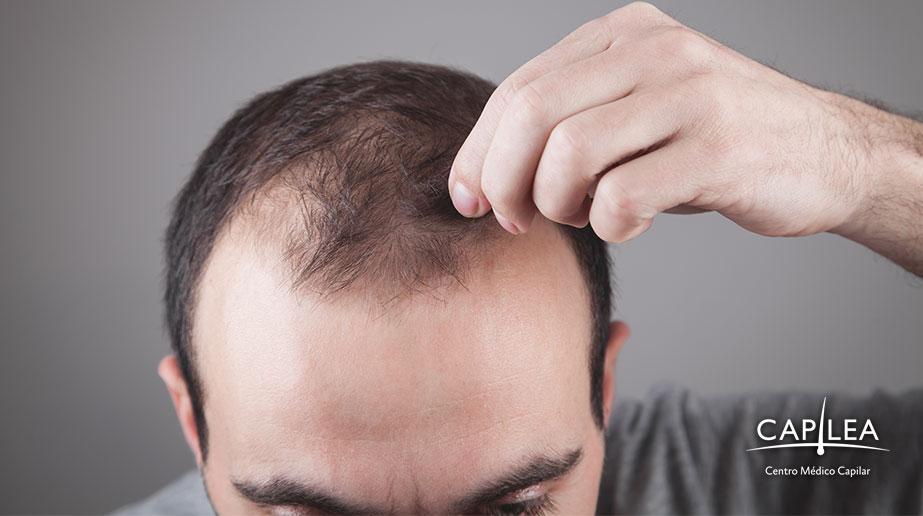
Are you worried about hair loss? You’re not alone. Millions of men around the world face male pattern hair loss and understanding where you are on the Norwood scale is crucial to addressing the problem effectively.
What’s the Hamilton Norwood scale for?
The Norwood scale, also known as the Hamilton-Norwood scale, is the gold standard for male pattern baldness. It was developed by Dr. James Hamilton in 1950 and revised by Dr. O’Tar Norwood in 1970, to provide a standardized way of measuring the progress of male hair loss.
Stages of the Norwood scale
Stage 1: Minimal hair loss
At this early stage, there is no noticeable hair loss or hairline recession. There are healthy hair follicles and the hairline is usually about 1-1.5 inches above the fold of the top forehead.
- No visible hair loss.
- The hairline maintains its original position.
- Full head of hair without thinning.
Stage 2: Slight hairline recession
Phase 2 marks the beginning of visible hair loss for many men. You may notice a slight recession in the hairline, particularly around the temples. This creates an M, U or V shape.
- Slight recession.
- The hairline can go back up to 1 cm.
- Some men can stay at this stage indefinitely.
Stage 3: Early signs of significant baldness
This is where hair loss becomes most noticeable and is generally considered the first stage of male pattern baldness. The hairline recedes more prominently into the temples, creating deeper “temporal bays”.
- Deep recession.
- Possible slimming in the crown.
- Hair loss becomes noticeable to others.
Stage 4: Severe hair loss
Stage 4 represents a significant progression in hair loss. The recession in the temples becomes more pronounced, and the hair on the crown thinning considerably.
- Widespread recession.
- Significant thinning or discoloration of the crown.
- Clear separation between the areas of baldness.
Stage 5: Advanced hair loss
The two bald areas and the crown begin to merge. The hair band separating the areas of upper and coronary baldness becomes much narrower and thinner.
- Larger areas of baldness on the top of the head and crown.
- Thin strip of hair remains between bald areas.
- The hairline keeps receding.
Stage 6: Extensive hair loss
The hair separates the bald areas at the top of the head and the crown disappears or becomes barely noticeable. Bald areas merge into a large area, and significant hair loss are on the sides of the head.
- Large area of continuous baldness on the top of the head.
- The sides of the head may show more thinning.
- The remaining hair is usually scarce.
Stage 7: Severe baldness
The final stage of the Norwood scale represents the most advanced form of male pattern baldness. Only a narrow band of hair remains on the sides and back of the head, forming a horseshoe shape.
- Horseshoe-shaped hairband around the sides and back.
- Completely bald top of the head.
- The remaining hair may be thin and less dense.
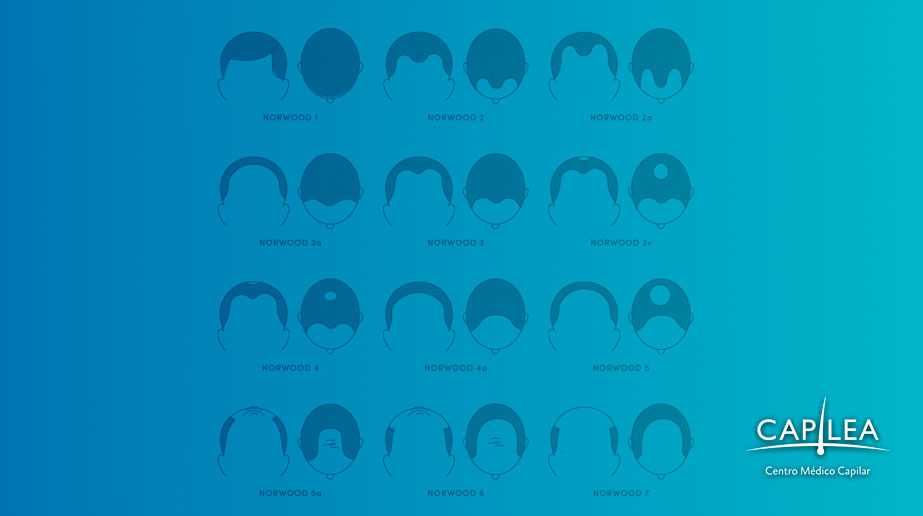
Have you identified what stage your hair loss is on the Norwood scale? At Capilea Mexico, we help you identify the exact stage and provide the treatment or hair transplant for your case. I am Dr. Héctor Treviño and I accompany you in this process. Schedule a free online appointment and regain your hair and confidence.